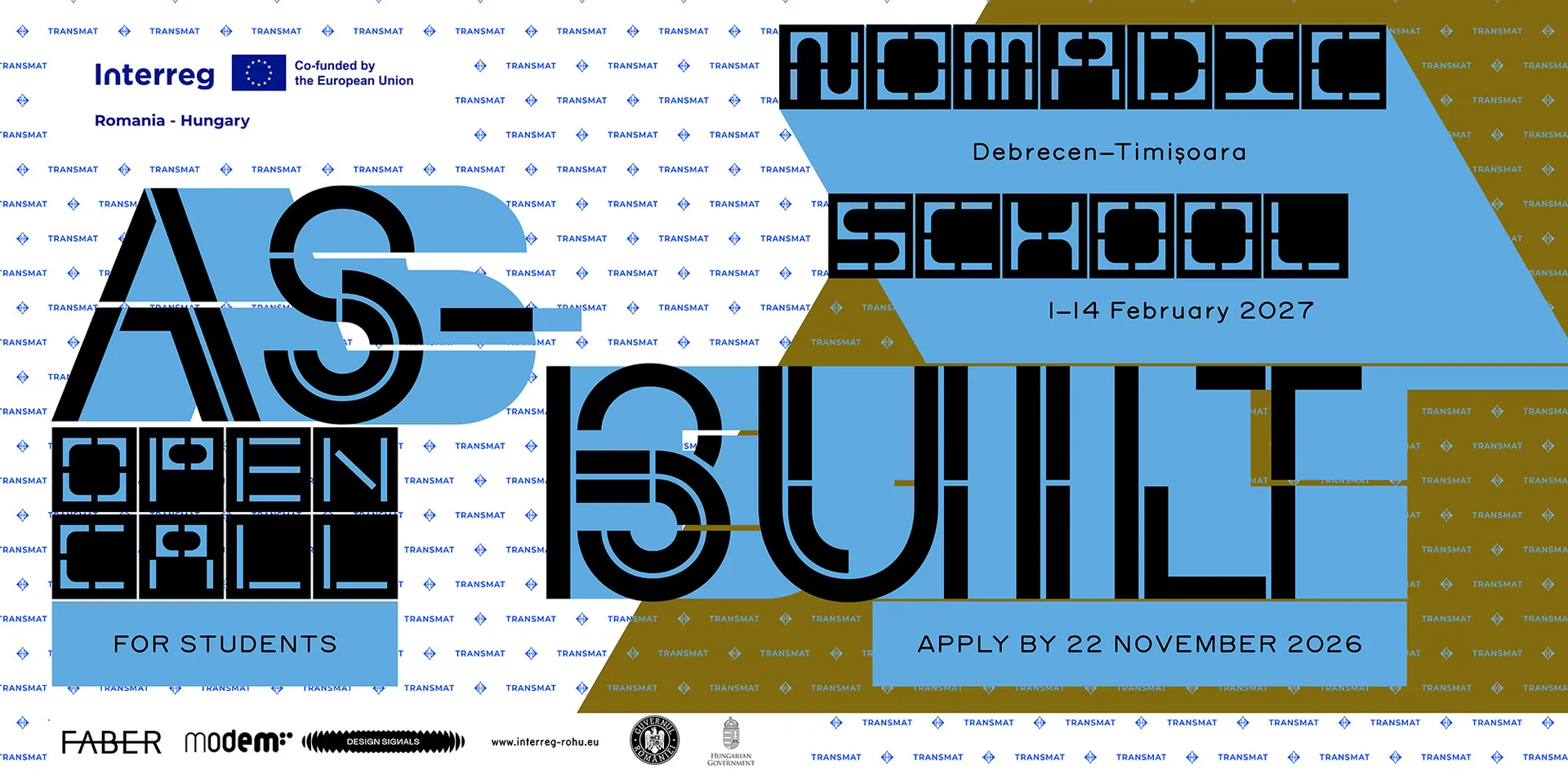
MODEM and FABER, through Interreg VI-A Romania-Hungary[www.interreg-rohu.eu](https://www.interreg-rohu.eu)), invite students and recent graduates in the fields of art, design, architecture, and related areas to take part in the "As-Built" Nomadic School, a two-week program of research, fieldwork, material experimentation, and project development taking place between Timișoara, an external field research location in northern Hungary, and Debrecen.
The Winter School is part of As-Built, the new edition of Design Signals, a collaborative programme focused on the construction and building materials industry in Romania and Hungary.
Sixteen participants will work with tutors, curators, invited experts and people working within and around the construction industry. Through site visits, conversations, documentation, material experimentation and making, they will develop individual or collaborative responses to the questions opened by As-Built.
The As-Built Winter School represents an occasion to participate in a nomadic educational experience between two cities and work in direct contact with the context outside the traditional classroom.
The participants will explore the context of the Timișoara and Debrecen construction ecosystem and have the chance to develop project proposals and prototype outcomes.
AS-BUILT: where plans meet reality
Construction is often presented as the execution of a plan. In practice, what gets built emerges through negotiation between design, regulation, finance, procurement, labour and material supply. Specifications change, budgets tighten, deadlines move and decisions accumulate. These are not incidental disruptions; they are part of how the industry operates. The passage from rendering, plan, investment or public announcement to building, road or neighbourhood materialises a layered set of political, economic and social values within the built environment.
An “as-built” drawing records the result of this process. Produced after construction, it documents what was completed, including changes made along the way. The difference between the original plan and the as-built record reveals where intentions were altered, which priorities prevailed and how responsibility was distributed. As-Built takes this gap as its central field of investigation.
The regions around Timișoara and Debrecen belong to an industrial landscape that has been repeatedly reorganised. Factories and infrastructures created for one economic system now operate within another. Ownership has changed, production has been retooled or reduced, and industrial sites have been repurposed as markets, regulations and technologies have shifted. At the same time, European policies are introducing new expectations for affordable, sustainable and inclusive living conditions. These ambitions encounter changing industrial networks, uneven labour markets, imported materials, rising land values and limited systems of maintenance.
Rather than treating these conditions as background, As-Built asks how they determine what gets built, where and by whom—and what happens after construction is complete. Through research in Timișoara and Debrecen, participants will engage with factories, construction sites, research centres and built environments. Projects will examine how decisions move through the construction process, whose knowledge is included or excluded, and where artistic, design and architectural practices might intervene—not only in new construction, but in what has already been built, left unfinished, adapted, repaired, standardised, maintained or abandoned.
Creative Research: tracing relations, opening possibilities
Art, design and architecture are understood as forms of research and practice: ways of tracing and redesigning how production, infrastructure and regulation shape a place. Rather than approaching the construction and building materials industry with a predefined problem or solution, As-Built invites participants to engage with the materials, processes, decisions and forms of expertise through which it operates, asking how construction can take agency into making, restoring or generating collective space.
This approach creates room to notice the needs and values that industrial production, shaped by capital and function, does not always accommodate. As-Built starts from the gap between what an industry is set up to do and what a place, a worker, or an ecology actually needs. Creative research can bring the priorities embedded in these systems into view and explore where they might be questioned or redesigned.
During the Winter School, participants will work with the MODEM and FABER teams in Timișoara, Debrecen and an additional field-research location in Hungary. Through site visits, conversations, documentation, material experimentation and collaboration, participants will investigate the realities of the construction and building materials industry, bring overlooked knowledge into view, and build connections between people and institutions that do not usually work together.
Open Call
What we are looking for
As-Built: Nomadic School invites students and recent graduates who want to investigate how the built environment is produced: how materials are extracted, transformed, and transported; how construction organizes labor, technologies, regulations, and finance; and how these systems become visible in buildings, infrastructures, and landscapes.
The Winter school is programmed to provide to the participants a contextual introduction to the locations of study. Applicants are invited to explore questions and curiosities close to their practices and in relation to the construction industry.
Applicants are encouraged to allow their initial questions and methods to develop through the people, places and processes they encounter during the programme. Prior knowledge of Timișoara, Debrecen or the field-research locations is not required.
Who can apply
The Winter School is open to international applicants who are:
Undergraduate students, master's students, or graduates who completed their studies within the last five years, working in art, design, architecture, or related fields.
Applicants should be available for the full duration of the programme, including travel between Timișoara, the intermediate field-research location and Debrecen.
The Winter School
Sixteen participants will be selected for the programme.
They will work with tutors selected from the fields of art, design and architecture.
Together with the curators and teams of MODEM and FABER, invited specialists, researchers and people working within and around the construction and building materials industry.
Three programme contexts
Debrecen
Fieldwork, on-site visits, meetings with local experts, and the development of initial research directions.
Field research in northern Hungary
An intensive period of fieldwork focused on a specific material, production process, infrastructure, or industrial condition.
Timișoara
Additional research, followed by elaboration, experimentation, and development of proposals.
The programme combines site visits, expert meetings, conversations, documentation, material experimentation, tutoring, individual and collective working sessions, and presentations.
Participation programme and outcomes
The Winter School develops through a sequence of field research, experimentation, making and proposal development.
Participants are not expected to produce finished artworks during the programme.
The Winter School ends with a final presentation in Debrecen. Each participant will present the proposal they have developed through the programme in material, spatial, visual, textual or other forms appropriate to their practice.
After the Winter School, 4 participants will be selected to continue developing their proposals into new works for the As-Built exhibitions at FABER in Timișoara and MODEM in Debrecen.
The four selected participants will receive further curatorial support and a production budget for the development of their work.
Open call launch: October 22, 2026
Application deadline:November 22, 2026
Selection results:within two weeks of the application deadline
The 16 participants will be selected bythe FABER curator, the MODEM curator, and the Winter School tutors.
What is covered
Participation in the Winter School is fully supported.
For all 16 selected participants, the programme covers:
- travel connected to participation — up to 500 € amount;
- accommodation;
- meals;
- transfers during the programme;
- programme and workshop costs.
Participants will also receive a stipend.
Provisional Programme
|
Dată
|
Locație
|
Program
|
|---|---|---|
| 31 ianuarie | Debrețin | Ziua sosirii — sosire și check-in |
| 1-4 februarie | Debrețin | Introducere în domeniul construcțiilor actuale, vizite la fața locului, întâlniri cu experți locali, cercetări pe teren și sesiuni de lucru |
| 5-6 februarie | Nordul Ungariei / locație de cercetare pe teren | Cercetare de teren axată pe un anumit material, proces de producție, infrastructură sau condiție industrială, alături de meditații și prezentări intermediare |
| 7 februarie | Nordul Ungariei / locație de cercetare pe teren | Zi de odihnă |
| 8 februarie | Transfer către Timișoara | Ziua transferului— călătorie și sosire |
| 9–12 februarie | Timișoara | Vizite la fața locului și cercetări suplimentare, urmate de experimentarea materialelor, realizarea și dezvoltarea propunerilor |
| 13 februarie | Timișoara | Prezentări finale |
| 14 februarie | Timișoara | Ziua plecării |
Application Guide
Fill out the online application form and submit:
Profile
- Name
- Current location
- University / program and level of study or year of graduation
- Contact details
- Website or online portfolio, if applicable
Short biography (maximum 200 words)
Portfolio (maximum10 pages)
The portfolio does not need to present professionally executed projects. It should help us understand how you observe, research, experiment, and create.
Application questions
- Why would you like to take part in the As-Built Winter School?Maximum 150 words.
- What part of the construction and building materials world are you curious about?This could be a material, site, process, technology, form of labour, infrastructure, regulation, environmental condition or something else you have noticed.Maximum 200 words.
- What would you like to observe, test or make during the Winter School?You do not need to propose a finished project. Tell us how you might begin exploring your interest through your own practice.Maximum 200 words.
- Are there particular materials, tools, techniques or ways of working that you would like to experiment with or learn more about?Maximum 150 words.
- Share one project, object, building, material, place, text or practice that connects to your interest. Why is it useful to you as a reference?Maximum 150 words.
Selection criteria
Applications will be considered in relation to the following:
Specific
The application starts from a material, a site, a process, a technology, a form of labor, an infrastructure, a regulation, or another concrete real-world condition.
This follows the existing As-Built criterion that proposals should be grounded in a real construction material, site, process, technology, labour condition, market logic or social urgency.
Experimental
The candidate demonstrates curiosity and openness to testing methods, materials, and approaches in fields such as art, design, architecture, industry, and research
Systemically informed
The applicant shows interest in understanding the actors, infrastructures, and systems surrounding the chosen starting point.
The As-Built professional call also asks proposals to be attentive to the actors, infrastructures, and markets that shape the construction industry and building materials.
Open to development
The candidate does not need to arrive with a resolved project. We are interested in the possibility that an initial question or interest may change through encounters, research, experimentation, and collaboration during the Winter School.
Shared learning environment
The final selection will also take into account the composition of the group. We aim to bring together participants with different practices, disciplines, perspectives, and ways of working, who can contribute to a productive and collaborative learning environment.
About MODEM
MODEM—Centre of Modern and Contemporary Art is a museum in Debrecen with 2,000 square meters of exhibition space. Exhibitions, projects, conferences, and educational programs examine art in relation to the culture and society of Central and Eastern Europe. MODEM also supports emerging artists and curators through grants, residencies, and the Debrecen Artist in Residence program.
As co-host of As-Built, MODEM brings the perspective of Debrecen — a city where infrastructure, land, labor, and regional development are part of everyday urban change.
About Design Signals / FABER
Design Signals is a long-term program initiated by FABER and curated by Martina Muzi. Working from Timișoara's industrial landscape, it brings together designers, researchers, institutions, and companies to investigate the relationships between contemporary design, industry, and technology. Each edition focuses on a strategic sector: automotive in 2023, textiles in 2024, chemicals in 2025, agriculture in 2026, and construction in 2027. The research is developed through exhibitions, workshops, and long-term partnerships.
The program is hosted at FABER, an independent cultural center founded in 2017 by Timișoara entrepreneurs active in architecture, IT, and the socio-cultural sector.
About Martina Muzi
Martina Muzi is a designer, curator, and educator, and her work examines design through material logistics, geopolitical cultures, and social structures. She has curated Design Signalsat FABER since 2022 and leads the Studio Technogeographies undergraduate program at Design Academy Eindhoven. In 2026, she is co-curator of the Rotterdam Architecture Biennale, Systems of Support, and curator of BIO 29: Soft Fields, the 29th Design Biennial organized by the Museum of Architecture and Design (MAO). Since 2024, she has also been curating ENTRATE, a multi-year program at MAXXI in Rome. Her work has been presented at the Venice Architecture Biennale, the Vitra Design Museum, the Istanbul Biennial, the MAAT Museum, and the M+ Museum of Visual Culture.
About Krisztián Gábor Török
Krisztián Gábor Török is a curator and art writer from Budapest, whose practice explores ecological imaginaries, situated knowledge, and the politics of memory and place through socially engaged and experimental exhibition formats. He has been a curator at MODEM Centre of Modern and Contemporary Art since 2022, where he developed Learning from Nature? — Botany, an exhibition and residency project with ten new commissions. Since 2025, he has also been curating the MODEM AIR program. His international projects include Breaking the Course of the European Boomerang at Pragovka Gallery in Prague and Index in Stockholm. He has taken part in programs at Ujazdowski Castle CCA, UNIDEE Biella, and the Curators Workshop of the 12th Berlin Biennale.
Funding Information
Project Title: TRANSMAT—Translocal Matters: Socially Engaged Arts and Design on the Borderlands
Implementation: November 3, 2025 – May 2, 2028 (30 months)
Project value: €2,500,326.98 | ERDF contribution: €1,598,284.00
Partners: MODEM Debrecen, FABER Timișoara
Type: Standard project | Culture and Sustainable Tourism | RS04.6
Jems Code: ROHU00265
The TRANSMAT project — Translocal Matters: Socially Engaged Arts and Design on the Borderlands is co-funded by the European Union through the Interreg fund, under the Interreg VI-A Romania-Hungary Programme. ([www.interreg-rohu.eu](https://www.interreg-rohu.eu))
The content of this material does not necessarily represent the official position of the European Union.