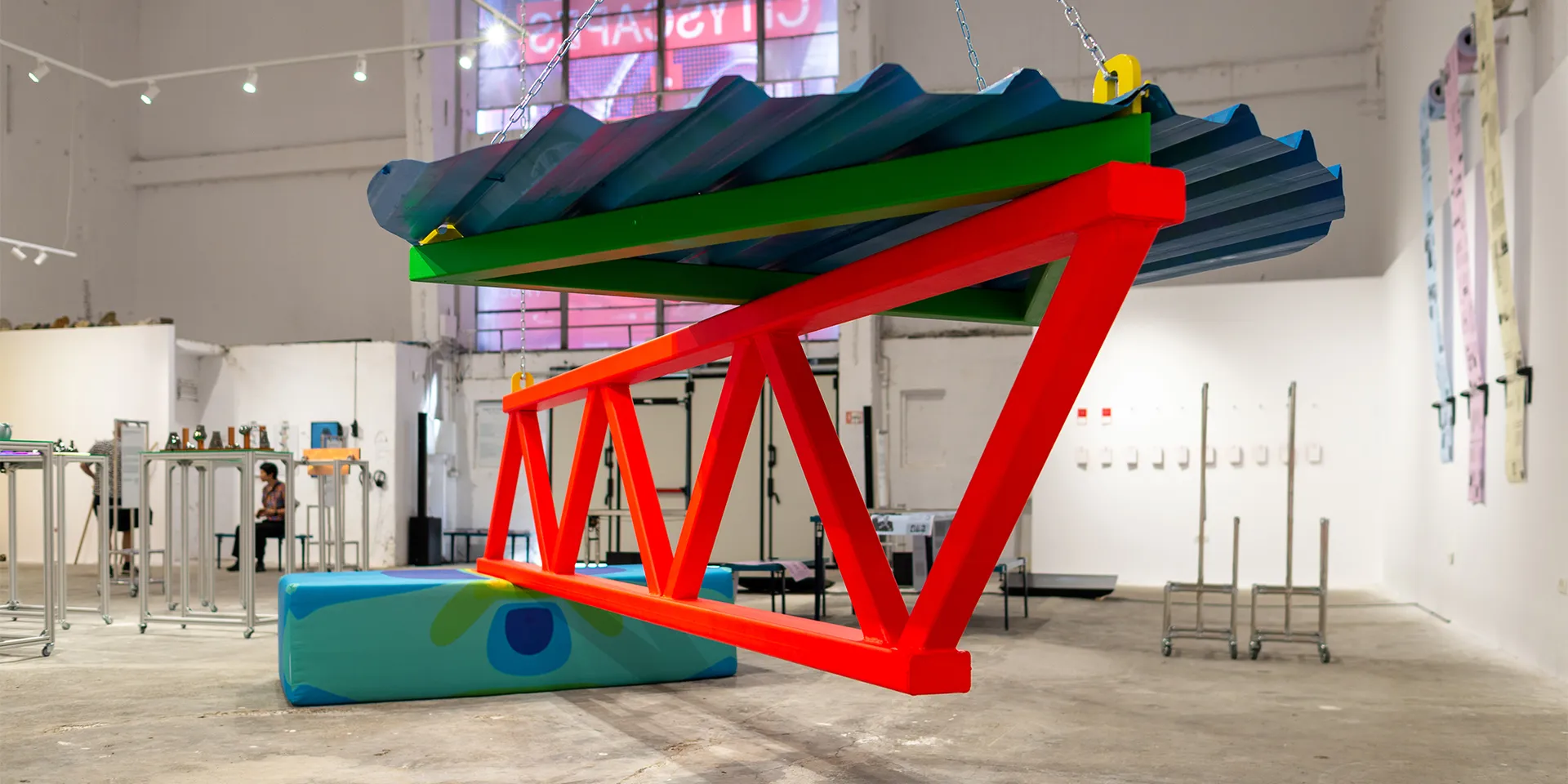
Design Signals is a long-term program initiated by FABER and curated by Martina Muzi, investigating the deep links between contemporary design, industry, and technology, starting from Timișoara’s evolving industrial landscape. The program is based on research situated within the production and academic ecosystem of Romania's second most important industrial city and involves designers, researchers, institutions, and creative networks, both international and local, in an ongoing dialogue about contemporary social and environmental challenges.
Each year, Design Signals examines a strategic industrial sector in Timișoara. Following its focus on automotive (2023), textiles (2024), and chemicals (2025), the program is set to explore agriculture (2026) and construction (2027). The initiative builds on insights from exhibitions and workshops, turning them into tangible products, innovative services, and public policies through long-term partnerships.
Chemical Bonds
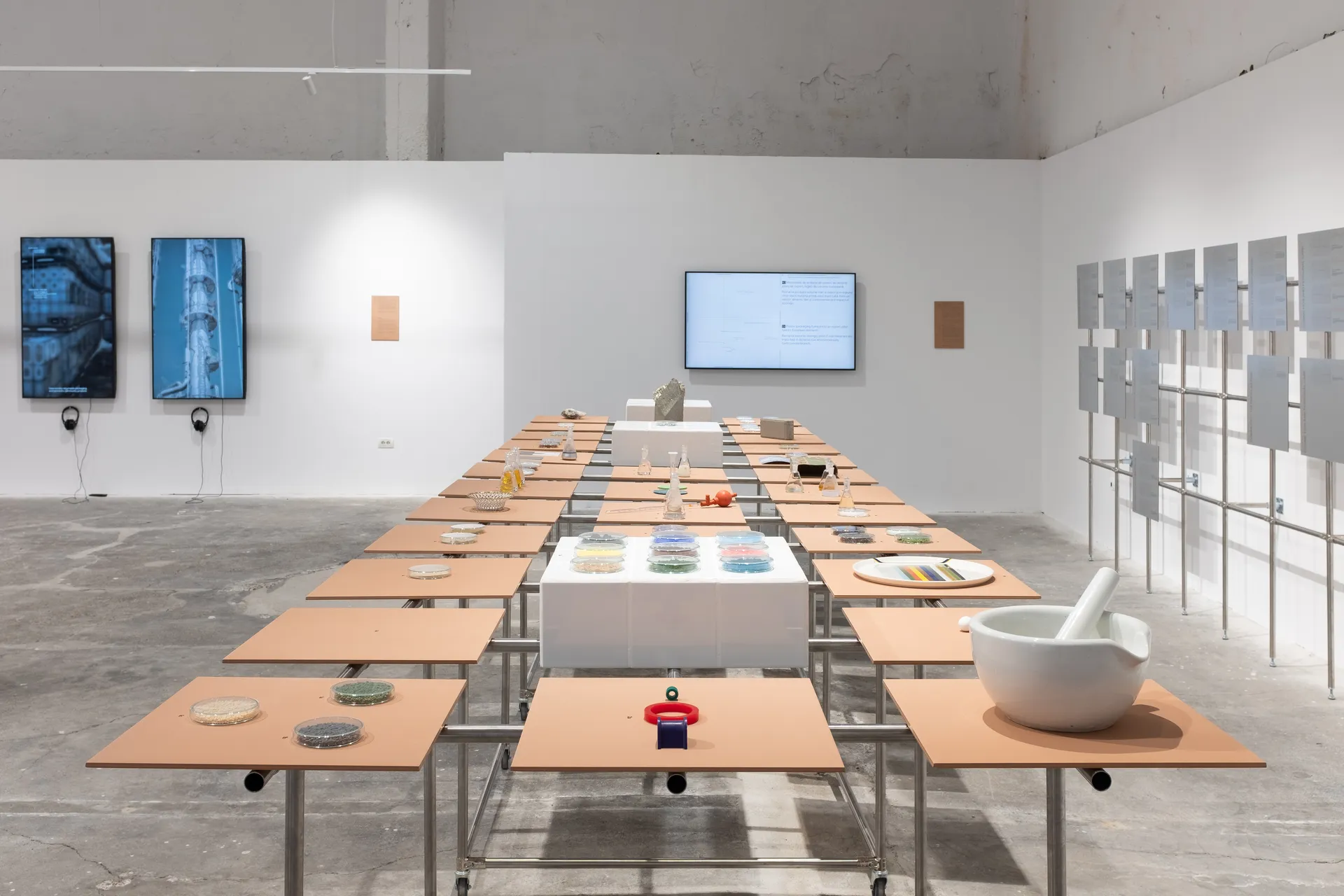
Traversing a Fragmented Landscape
Chemistry is both a science of transformation and a structure of control. It governs the materials that shape our world—through bonds forged between atoms, and through policies, patents, and industrial standards. Its industry supports countless others, from agriculture to automotive, from textiles to tech. At the same time, the sector is weighed down by stigma—often perceived as a polluting, extractive force—when it is foundational to modern life. But in Romania, the chemical sector also reveals a system in crisis: fragmented infrastructure, underused expertise, and limited space for innovation.
`Chemical Bonds` exhibition confronts this tension. It asks what kinds of design practices are possible when access is restricted, when knowledge is siloed, and when an entire industry operates at the thresholds of visibility. Designers, researchers, companies, and institutions come together to trace how material, labour, and expertise circulate—or stall—across the chemical landscape.
This begins with research: a report by sociologist Norbert Petrovici maps the disintegration of Romania’s once-integrated chemical platforms and the regulatory and structural barriers that prevent innovation. A second phase followed on the ground: over twenty site visits produced interviews, photographs, and documentation that reveal everyday strategies of maintenance, care, and adaptation.
The commissioned design projects work within this complexity: glaze as forensic tool, salt as industrial ritual, bioplastics as surface, and galvanization as gesture. Also on display are outcomes from a schools programme, where design students and tutors explored chemistry’s role in daily life; and a journalistic collaboration investigating Romania’s position in Europe’s green transition—particularly around resource extraction and industrial policy.
Hosted in the former Azur factory, once a soap and varnish production site, the exhibition is designed from repurposed tiles and structural components sourced from chemical facilities. It operates as a lab, archive, and site of public engagement—where design helps make hidden bonds visible, and perhaps renegotiable.
`Chemical Bonds` does not offer solutions. Instead, it opens a space where new interdependencies might take root. In a sector marked by systemic problems, design is not used to simplify complexity, but to pose deeper questions about how we live with chemistry. The responses are not always clean. But they are necessary.
Woven Secrets
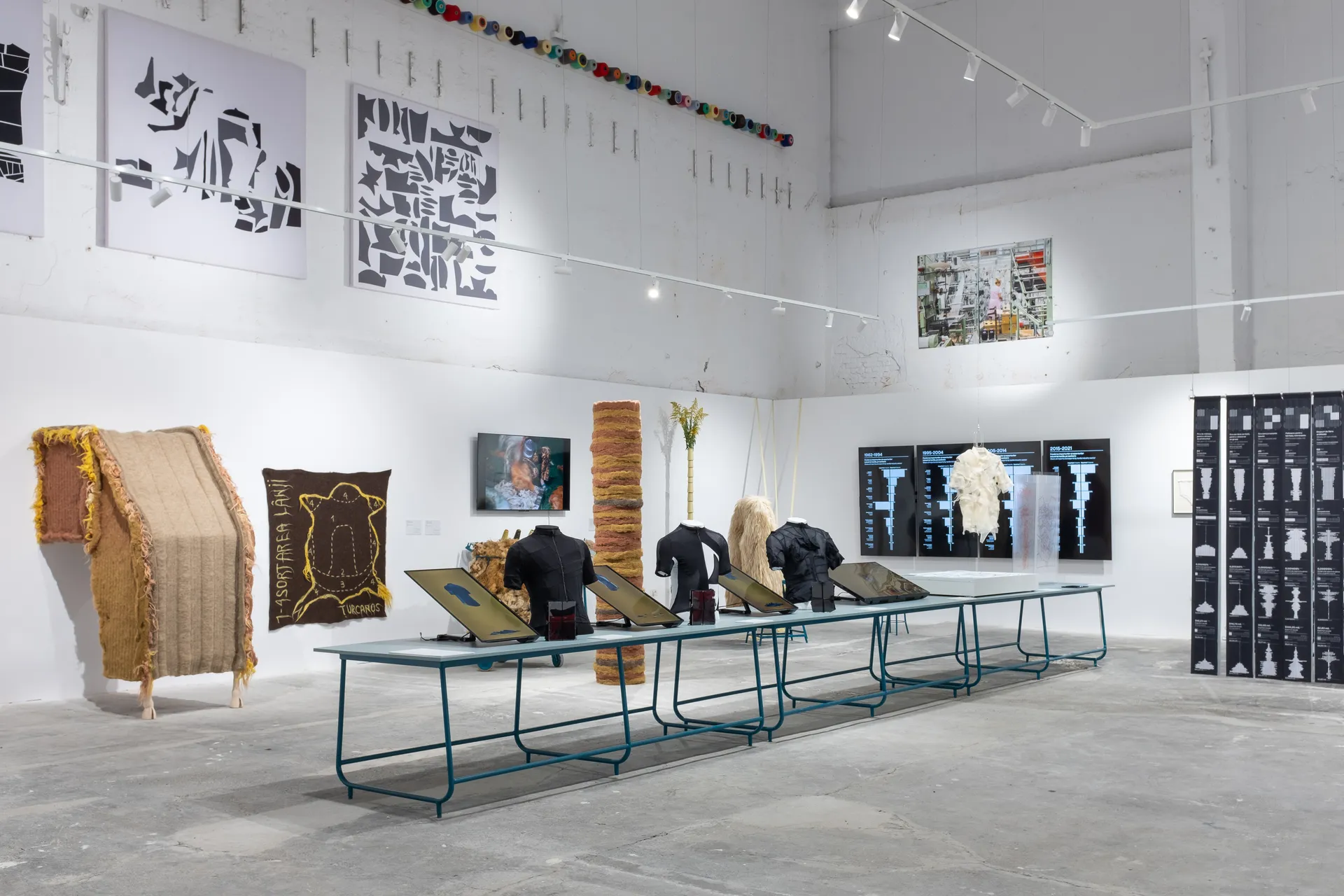
Since Romania’s accession to the European Union, the textile industry has experienced significant changes. Historically, large state-owned factories were central to Timișoara’s economy and community life, shaping entire neighbourhoods and livelihoods. However, with increased EU-wide competition, mass production has declined. Today, while the industry is less visible, it is far from obsolete. Smaller, more flexible manufacturing systems have emerged, deeply interconnected with sectors such as automotive, chemicals, and agriculture. Textiles are no longer limited to traditional apparel or home categories but are now integral to more complex products and export chains.
`Woven Secrets` traces the fragmentations and transformations of Timișoara’s textile industry, revealing the overlooked design behind the city’s economic and social evolution. Part of FABER’s ongoing Design Signals research programme, which investigates the design ecosystem of Timișoara, the exhibition commissioned the research report ‘Shifts in Global Textile Markets: Romania's Role in the Global Value Chain from 1962 to 2022’. It showcases Romanian designers—partly selected through an open call—who have collaborated with local experts, producers, and manufacturers to develop work that presents prompts for reimagining the future production in the city.
The projects in `Woven Secrets` go beyond observation, actively engaging with and restructuring the industrial and cultural landscape. Designers work with waste materials, explore new production methods, and form unexpected collaborations that challenge traditional profit-driven supply chains. Some projects function as design laboratories, demonstrating how design can bridge scales and connect disparate manufacturing systems, archives and communities. The works also emphasise the deep expertise of Romanian workers, and the significance of textile in Romanian culture. Incidental design is revealed in labour, relations and landscape, in as much as it is obvious in products, entrepreneurship and innovation.
`Woven Secrets` reframes the textile industry as a complex, interconnected sector reflecting broader economic trends in Romania, Europe, and global production systems. The exhibition underscores design’s power to disrupt conventional production models and presents bold, visionary approaches to making, producing, and collaborating.
Turn Signals—Design is not a dashboard
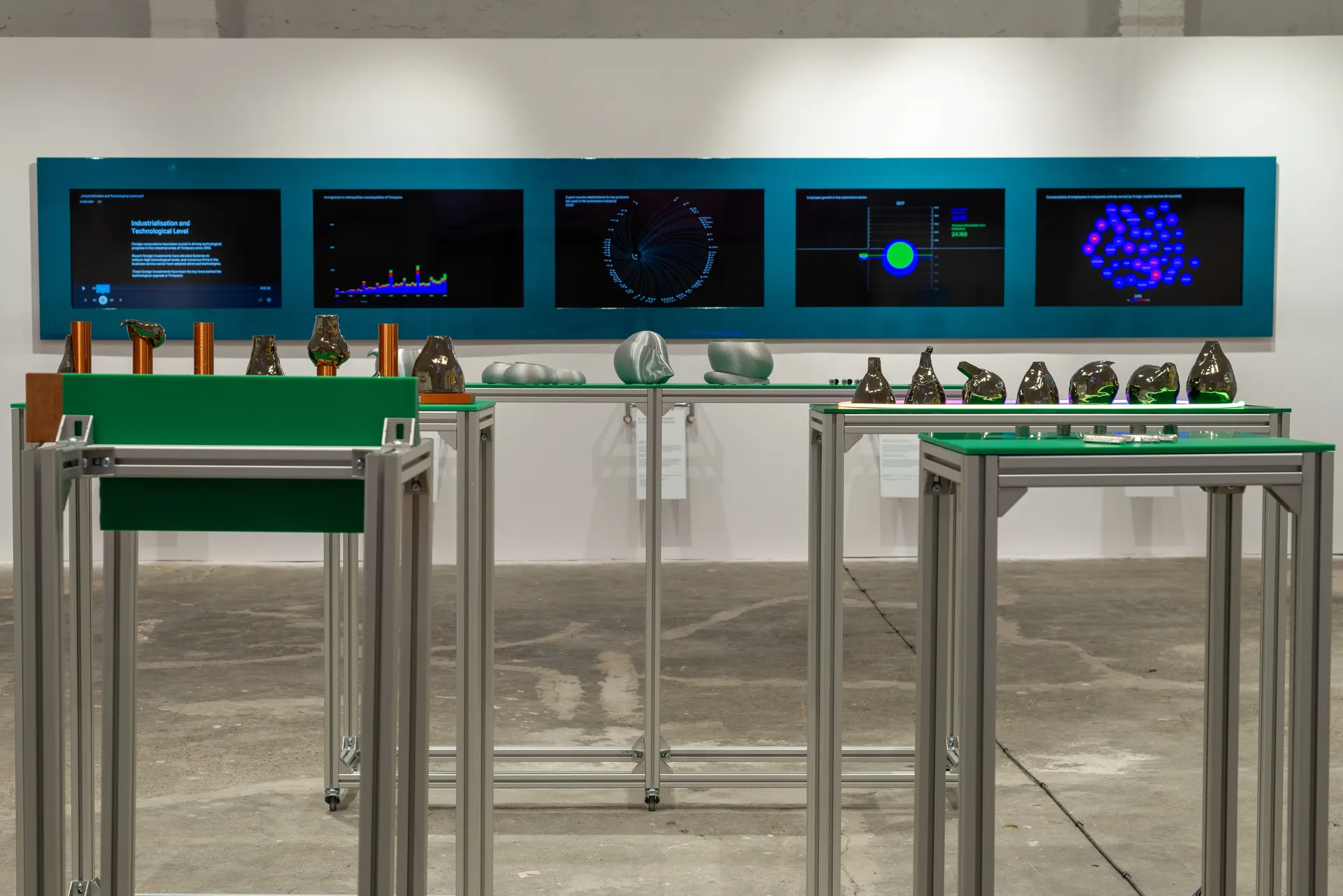
Since Romania joined the European Union, its manufacturing sector has experienced substantial growth. Simultaneously, the global manufacturinglandscape is undergoing a profound transformation due to rapid digitalisationand the integration of global supply chains, making innovation a paramountnecessity for the country.
This expertise is evident throughout Timisoara,in its industrial parks, specialised labour market, and technical universities.Interconnected networks of knowledge, resources, and values not only facilitatemultinational corporations, city developments, and academic laboratoriesbut also continue to honour the city’s engineering legacy. However, thepotential of design often remains untapped and concealed within academicresearch networks, corporate intellectual property, mechanical components,sophisticated technological objects, and profit-driven logics.
`Turn Signals—Design Is Not A Dashboard` is an exhibition that exploreshow design can act as a conduit for collaborative ventures that go beyondthe confines of established manufacturing parameters. Anchored withinthe contextual framework provided by a commissioned report, ‘Economyin Timisoara: Territorial Distribution of the Economy in the TimisoaraMetropolitan Area’, the exhibition invited multidisciplinary practitioners tocollaborate with local researchers, interpreting the statistical data throughthe designed lenses of devices, bodies, agents, media, forces, and networks.These collaborations drew from existing research, leveraged the localengineering network, and engaged with well-established knowledge systemswithin and beyond Timisoara’s industrial ecosystem. The resulting projectsconverge at the crossroads of information asymmetries across disciplines,supply chain stages, computational processes, the collective imagination,material cultures, and the expansive manufactured environment. By observingand reinterpreting the navigational pathways of these asymmetries, theseprojects signal the presence, concealment, and imminent transformation ofdesign within Timisoara.
The exhibition’s title draws inspiration from an indispensable everyday object produced in local and multinational automotive plants in Timisoara—the turn signal indicators on vehicles, used to communicate directional shifts to fellow drivers. These indicators, enmeshed within the intricacies of engineering processes and nestled onto dashboards, exemplify the potential for design to be limited to mechanical refinement and obscured by technological complexities. By exceeding the confines of a mere dashboard, the design practices and discourses in the exhibition have explored the city’s products and resources from local and global perspectives, connecting places, people, and urgencies across different scales. The exhibition serves as a turn signal to Timisoara, inviting a new trajectory for the city’s design, architecture, and digital culture.
Economy in Timisoara—Territorial distribution of the economyIn the Timișoara Metropolitan Area
The entire design program is built on the study conducted by Norbert Petrovici in 2022. This comprehensive study analyzes Timișoara’s economic history from various angles. The pre-war era (1850-1910) marked the city’s initial industrial growth, while the interwar period (1918-1940) saw the interconnection of rural and urban areas through industrial investments. The socialist era (1950-1990) brought mechanization and growth in agriculture and industry. Economic restructuring (1990-2020) attracted foreign investment and shifted migration patterns. Timișoara’s economic structure (2022) revolves around manufacturing, services, and the automotive sector. The study also examines the role of foreign direct investment (FDI) in the economy and its impact on local companies, highlighting specific sectoral trends and ownership networks.