Author
Drd. arh. Radu D. Radoslav
Abstract
This article proposes an understanding of nightlife as part of the city’s social, cultural, and economicinfrastructure. Starting from a dual experience, as an urban planner and as an actor involved inTimișoara’s alternative music scene since the 1990s, the text argues that nightlife must be recognized asa legitimate urban stakeholder. The evolution of dance venues in Timișoara, mapped by decade, revealsa significant decline in active spaces after the period of greatest diversification in the 2000s and 2010s.This decline is connected to broader urban processes: real estate development, residential pressure,urban sprawl, fire safety regulations, the pandemic, changing lifestyles, and economic or managementdifficulties. At the same time, the article argues that nightlife is a competitive asset for the city, relevantboth for attracting investment and workforce, and for positioning Timișoara as a university and culturalcenter in relation to other urban centers. For this stakeholder to be integrated into planning processes,its importance within the city must be recognized, both culturally and economically, and this recognitionmust be supported by instruments of analysis and coexistence.
Keywords: nightlife, urban planning, stakeholders, intangible cultural heritage, Timișoara, clubbing,social infrastructure, urban coexistence
1. Introduction. Two Biographies Meeting in the Same City
The presentation delivered at FABER started from a personal and professional position that, for a longtime, had operated in parallel. On the one hand, I am an urban planner, and I work with the instrumentsthrough which the city is read, regulated, and designed. On the other hand, I am one of the actors ofTimișoara’s alternative scene, involved since the 1990s in the development of club culture, undergroundevents, and the musical communities built around them.
This dual positioning becomes relevant when the city is understood as the product of several types ofaction. It is built through plans, regulations, investments, infrastructure, and administrative decisions. Atthe same time, the city is built through cultural practices, social rituals, temporary uses, nocturnalroutes, informal spaces, and forms of belonging that rarely appear clearly enough in official planningdocuments.
In the presentation at FABER, I tried to bring together these two dimensions of my own experience. Theurban planner and the DJ can no longer be separated when the subject under discussion is nightlife.After more than three decades of activity in different cultural, musical, and urban environments, itbecomes evident that the alternative scene is one of the forms through which the city expresses itsenergy.
In this sense, nightlife cannot be reduced to consumption, entertainment, or noise. It represents a formof social and cultural infrastructure. Through it, the city tests its diversity, its capacity for coexistence,and its ability to accommodate different ways of using space. Clubs, bars, terraces, former industrialspaces, waterfronts, converted halls, temporary events, and alternative spaces have functioned inTimișoara as places of encounter, experimentation, and cultural expression.
The article starts with this observation and proposes a shift in perspective: nightlife must be understoodas an urban stakeholder. It has actors, interests, vulnerabilities, economic impact, cultural impact, andeffects on the image of the city. Without such recognition, nightlife remains an informally toleratedfunction, easily marginalized by real estate development, by regulations applied without adaptation tocontext, or by urban plans that no longer read the existing realities on the ground.
2. Nightlife as Living Local Heritage
Club culture in Timișoara, especially the underground scene, can be read as part of the city’s intangiblelocal heritage. This statement requires a broader understanding of heritage. Just as a historic buildingcan be catalogued as part of the city’s heritage, urban culture can also be recognized as part of itshistory. This is a heritage of practices, communities, places activated through repeated use, andcollective memory produced over time.
Our city has a tradition associated with the “Timișoara spirit”, with cultural openness and with a certainform of local rebellion. This dimension appears in different forms of urban culture: music, visual arts,alternative spaces, independent scenes, clubbing, temporary events, and communities that built theirown contexts when institutional cultural infrastructure was limited. In this sense, the undergroundscene is not a mere annex to cultural life. It is one of the expressions of the local urban DNA.
Films such as Swamp City capture precisely this relationship between the city, alternative culture, andlocal identity. They show a city that is also built through subcultures, gestures of independence, thetemporary occupation of spaces, improvisation, and the need to create places for communities that donot always find themselves represented in official forms of cultural representation.
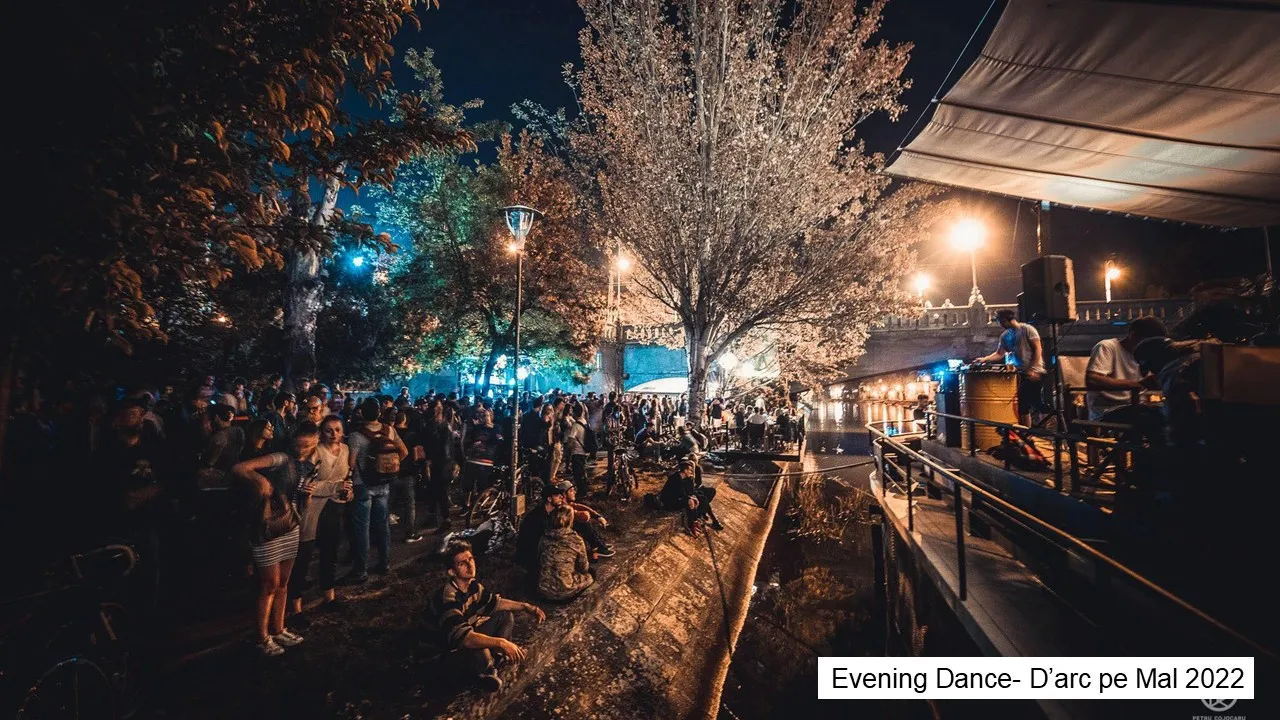
In the case of Timișoara, this history is connected to a succession of places and moments that markedthe evolution of nightlife: the first raves, events in former industrial spaces, dance venues from the1990s and 2000s, events on the banks of the Bega, clubs that became landmarks for differentgenerations, the Evening Dance series, events on the Pelican boat, temporary interventions, andconversions that transformed apparently marginal spaces into landmarks of the nocturnal city.
AnonimTM, founded in 1998, is part of this history. Its activity is part of the evolution of the localunderground scene and of the way in which Timișoara learned to use unconventional spaces for culture.From this perspective, clubbing is also a form of city-making. It creates routes, landmarks, rhythms,communities, and memories. When such a place disappears, part of the affective infrastructure of thecity disappears with it.
3. Nightlife as an Urban Stakeholder
In urban planning, the notion of stakeholders refers to actors who have interests, influence, orvulnerabilities in relation to an urban decision. Most often, these actors are identified in relation toproperty, investment, administration, neighborhood, or infrastructure. However, the real city is morecomplex than this scheme. It is used, produced, and affected by far more diverse groups.
Nightlife has its own ecosystem of actors: organizers, DJs, musicians, technicians, clubs, bars, culturaloperators, audiences, night workers, security companies, taxi drivers, ride-hailing services, suppliers,restaurants, food and beverage venues, property owners, neighbors, public administration, firefighters,local police, real estate developers, cultural institutions, universities, and tourists. All these actorsparticipate, in one form or another, in the functioning of the nocturnal city.
Placing nightlife in the position of stakeholder does not mean giving it absolute priority. It meansrecognizing that it exists, produces effects, has needs, and must be integrated into urban managementmechanisms. Each of these uses produces urban relationships, generates economy, activates publicspace, creates identity, and may come into conflict with other functions.
For this reason, the essential questions are: who are the actors involved, what are their interests, whatis their influence, and how can they be involved in the process? These questions can be applied directlyto nightlife. They allow a shift from punctual reaction to urban management. Instead of addressingproblems only when a conflict appears, the city can build instruments of coexistence in advance.
This approach is particularly important in neighborhoods and urban areas where nightlife has developedin relation to historic spaces, former industrial platforms, the banks of Bega, or mixed-use areas. In suchplaces, the conflict between housing, leisure, cultural activity, built heritage, mobility, and safetyrequires a reading of the character of the place and instruments that allow regulations to adapt to urbanreality.
4. The Decline of Dance Spaces and the Fragility of the NocturnalCity
The presentation at FABER proposed a decade-by-decade mapping of dance venues in Timișoara. Thismapping should be read as an X-ray of an urban dynamic. It shows that, after a period of growth anddiversification, the number of active spaces dedicated to dancing and nightlife began to decline visibly.
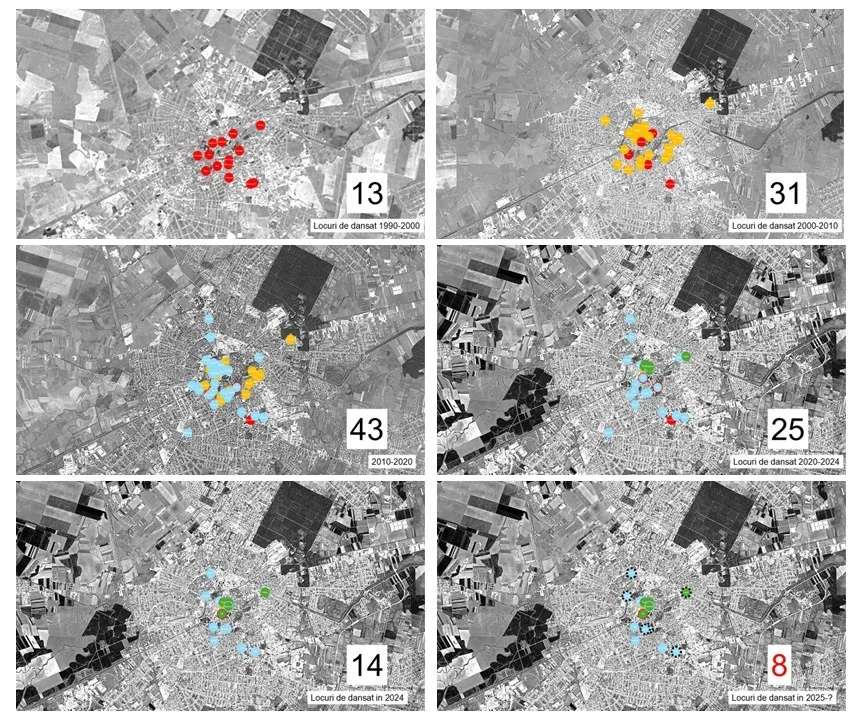
For the period 1990-2000, the map of dance venues indicates a scene in formation, with landmarks stillconnected to the first clubbing spaces, to the first attempts to introduce electronic music, and to placesthat functioned in a city still undergoing transition. In the period 2000-2010, the scene expanded,diversified, and came to include a larger number of spaces. Between 2010 and 2020, a peak in densityand diversity can be observed, with multiple clubs, bars, terraces, alternative spaces, and event venues.After 2020, the decline accelerated, and the recent situation shows a significant reduction in the placesavailable for dancing and nocturnal events.
This decline has several explanations. The development of the city and real estate pressure changed thecharacter of certain areas. Fire safety regulations became stricter, especially after the Colectiv tragedy,and many cultural or event spaces located in historic buildings or former halls became difficult to adapt.The pandemic directly affected clubs, bars, events, and public habits. Changing lifestyles reduced thefrequency of going out at night for certain categories of the public. Financial and management problemsweakened independent operators.
At the same time, the entire metropolitan area of Timișoara is facing the risk of urban sprawl that isdifficult to control. The expansion of residential areas and the transformation of peri-urban landproduce a development model in which cultural, nocturnal, experimental, or noisy functions are rarelyplanned. Housing expands, social infrastructure remains under pressure, and spaces for independentculture are left to chance. In such a model, nightlife becomes vulnerable because it has no clear positionwithin the logic of urban development.
Nightlife cannot function exclusively through occasional events. It needs infrastructure, routes,recurrence, visibility, and a certain degree of stability. Without these fragments, the audience is lost,and the city becomes culturally poorer.
5. Urban Development, Masterplans, and Conflicts with Reality onthe Ground
One of the major risks for nightlife appears when urban development takes place without sufficientreading of existing functions. Masterplans, conversion strategies (the RIM areas of Timișoara’s GeneralUrban Plan), and general regulations may come into conflict with already established local realities. Aspace used for events for years may be treated as land available for new development. An area withcultural identity may be redrawn as a simple residential frontage. An active function may be lostbecause it is not recognized as an urban value.
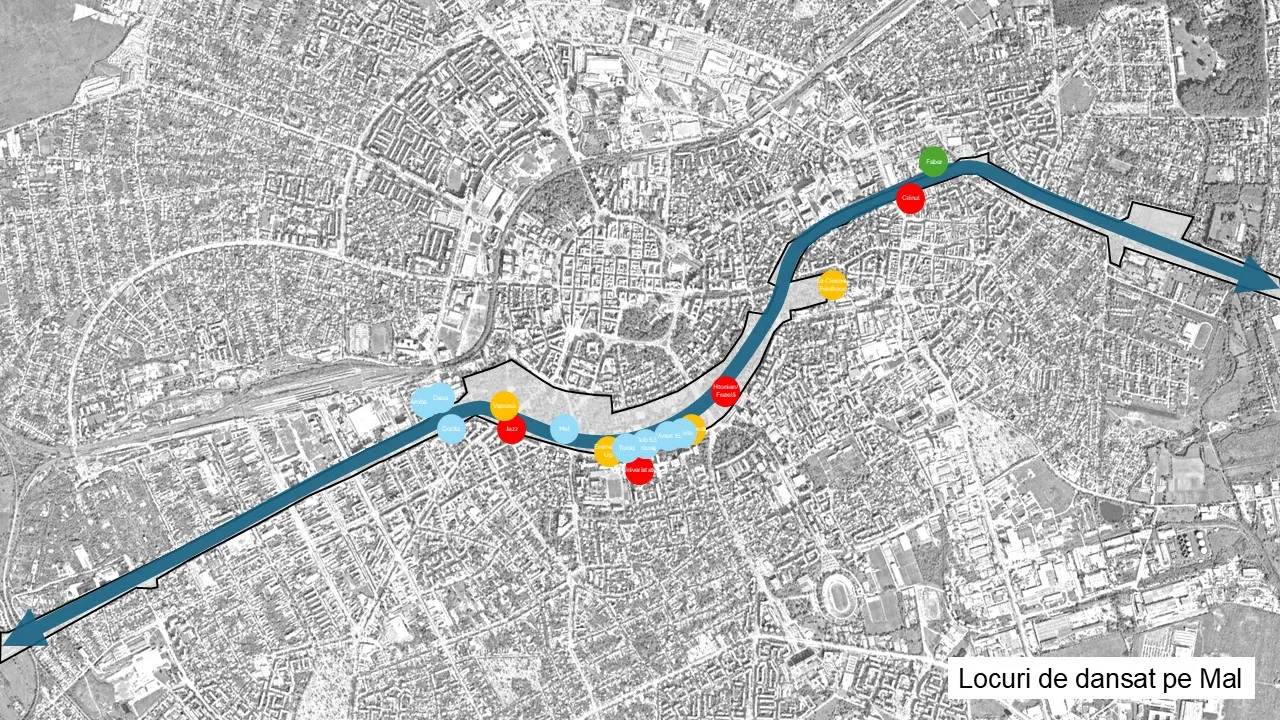
This is also visible in the relationship between nightlife and the banks of the Bega. Over time, theriverbank has functioned as a support for events, terraces, clubs, meeting places, concerts, and forms ofurban socialization. It offers a type of space that is difficult to replace: open, accessible, recognizable,with a direct relationship between city, water, and community. Events held on the riverbank showedthat public space and nightlife can together produce urban identity.
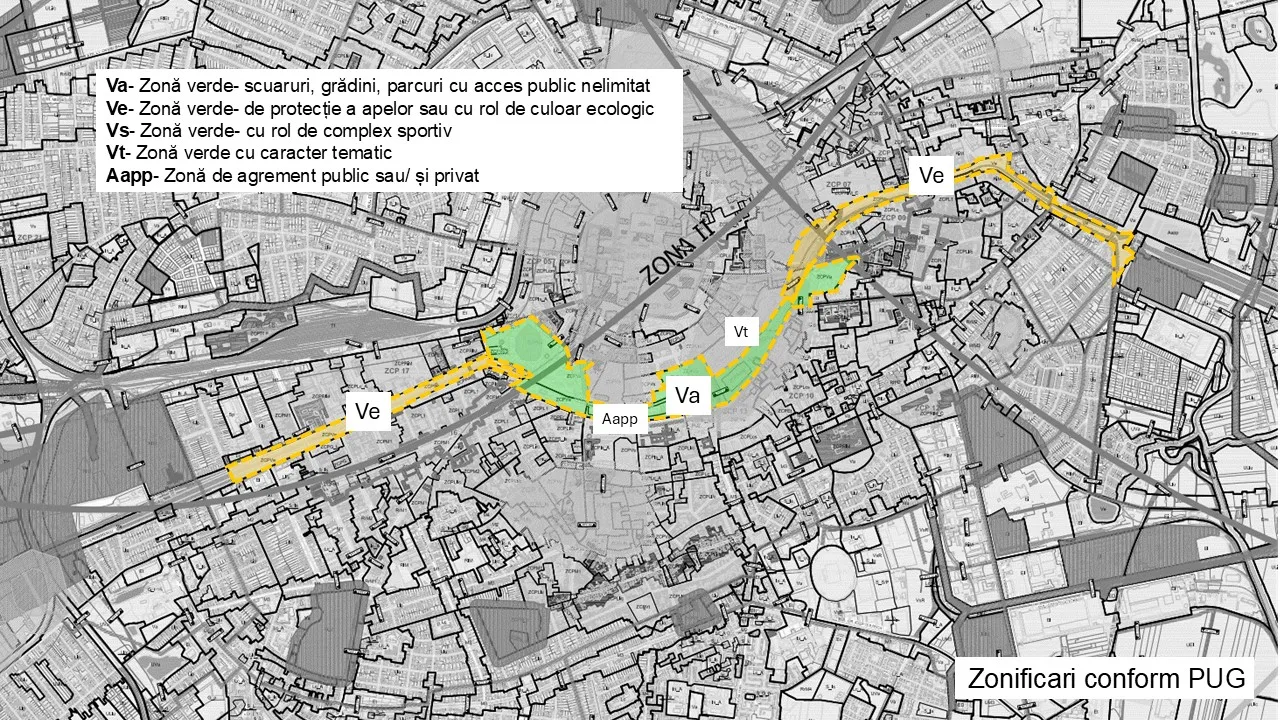
At the same time, urban regulations applied to the riverbanks may have very different effects dependingon the way they define leisure, food and beverage activities, clubs, terraces, green spaces, sports,ecological corridors, and housing. A green or leisure area may allow cultural and leisure activities, butmay impose conditions which, if applied rigidly, limit precisely the types of uses that produced thecharacter of the place. This is why context is always important. Not every green space is identical, notevery leisure area functions in the same way, and places with their own cultural history must be readthrough their real character.
Another conflict appears in relation to fire safety regulations. After Colectiv, the tightening ofrequirements was necessary and justified by the need to protect the public. However, for independentcultural spaces, historic buildings, and former industrial spaces, compliance can become extremelydifficult. Costs, constructive constraints, and uncertainty around authorization can lead to closure.Safety must be treated as a mandatory premise, but the city also needs mechanisms through whichvaluable cultural spaces can be helped to adapt, including through public infrastructure investments thatreduce the pressure of individual compliance. For example, the introduction of an exterior hydrantnetwork in the pedestrianization project of the Cetate area could have supported venues in Piața Uniriiand its proximity in obtaining fire safety approval, without each operator being forced to solve,separately and through costly solutions that are difficult to place in historic buildings, their own firewater reserves or tanks.
Without such mechanisms, regulation ends up producing a paradoxical effect: it protects the public byeliminating the places where the public can meet. From an urban planning perspective, this situationmust be discussed with maturity. The solution must include funding, technical guidance, phasing,adaptation to existing buildings, specific guidelines, and real collaboration between administration,cultural operators, designers, and approval authorities.
6. Nightlife as a Competitive Asset for the City
Nightlife is also an urban asset. It contributes to the city’s attractiveness for residents, students,employees, visitors, investors, and creative communities. In a competitive urban economy, quality of lifeis not reduced to salaries, housing, and technical infrastructure. It includes culture, restaurants, publicspaces, events, the philharmonic, theatre, sports, creative communities, and, inevitably, the party.
Any multinational company analyzing the opening of a new activity in a location evaluates the localenvironment. Beyond salary levels, workforce availability, accessibility, and infrastructure, what mattersis what the city offers to future employees. It matters whether there are restaurants, cultural spaces,events, social life, leisure options, and an urban scene capable of supporting an attractive lifestyle. Inthis package, nightlife has a real role, even if it is rarely formulated explicitly in urban planningdocuments.
The same applies to universities. University cities are in increasingly strong competition to attractstudents, in a difficult demographic context, with smaller generations and increased mobility. Timișoaracompetes directly with other university centers, including Cluj, and the difference between cities is notmade only by the range of study programs. Students also choose a living environment. They choose thecity where they will live, socialize, go out, work, build relationships, and perhaps remain aftergraduation.
In this competition, cultural life and nightlife are components of urban attractiveness. A city withoutmeeting places, without a music scene, without alternative spaces, and without nocturnal energy risksbecoming less convincing for young people and mobile professionals. For this reason, nightlife must betreated as a resource for urban development, not as a public order issue managed only on a case-by-case basis.
This approach also has a direct economic dimension. A night out generates a succession of expenses:transport, restaurant, ticket, drinks, related services, transport back home, consumption before andafter the event. The economy of nightlife is not limited to the club. It activates a network of services andjobs. When this economy shrinks, the city loses revenue, activity, visibility, and attractiveness.
7. From “Nightlife” to “Party”: The Sign of Fragility
The phrase “Party: formerly known as nightlife” describes an important shift. Nightlife, in its completeurban sense, implies a network of places, continuity of programming, a recurring audience,communities, infrastructure, routes, and memory. The punctual party can exist without this network. Itappears temporarily, uses an opportunity, occupies a space for one night, and then disappears. It is aform of cultural resistance, but also a symptom of fragility.
When the city can no longer support stable nightlife, the punctual event becomes the substitute for anecosystem. This transition produces losses that are difficult to measure. The continuity of thecommunity is lost, the recurrence of the audience is lost, technical skills are lost, and the capacity toform new generations of artists, DJs, organizers, and audiences is lost. The city remains with events butloses its scene.
This difference is important for urban planning. A punctual event can be authorized through temporaryprocedures. A cultural scene needs urban policy. It needs space, predictable rules, compatibleneighboring functions, access, night-time transport, noise management, safety, and instruments ofcoexistence.
8. What Must Be Studied in Order for Nightlife to Be Protected
For nightlife to become a real urban stakeholder, it must be supported by data and studies. Incontemporary planning, the simple statement that an urban stakeholder is important is not enough. Itmust be described, measured, mapped, and correlated with the other systems of the city.
The first level is noise study. Nightlife produces sound, and sound must be managed. The differencebetween disruptive noise, amplified music, ambient sound, and nocturnal discomfort must beunderstood technically. Noise maps can allow the establishment of tolerance zones, differentiatedlimits, constructive measures, and operating conditions adapted to context.
The second level is lighting study. Night spaces use light, and light influences safety, comfort, urbanimage, and the natural environment. In areas close to ecological corridors, water, parks, or greenbuffers, lighting must consider its impact on fauna, birds, and insects. At the same time, certain spacesneed safety lighting for access, pedestrian routes, crossings, passages, riverbanks, or risk areas.
The third level is mobility study. Nightlife generates movements during time intervals that differ fromthose of the daytime city. Access to clubs, the return home, taxi availability, night-time public transport,parking, pedestrian routes, and traffic safety must be treated together. A city that wants nightlife mustbe able to support nocturnal mobility.
The fourth level is the safety and security study. Nightlife involves crowds, alcohol consumption,extended opening hours, spaces with controlled evacuation, and intense social interactions. Theseaspects require clear rules, qualified staff, evacuation routes, access for intervention, collaboration withauthorities, and adapted protocols. Safety is a condition for the existence of nightlife, not an externalobstacle to it.
The fifth level is economic study. The impact of nightlife must be calculated in terms of direct spending,jobs, activated services, tourist attractiveness, youth retention, urban image, and effects on creativeindustries. Such an evaluation can show that nightlife is a component of the urban economy and a factorof competitiveness.
These studies should become a component part of any serious urban planning documentation or studythat intervenes in areas with existing, possible, or historically relevant nightlife, and they must beconceived bidirectionally. They must also evaluate the impact of the city on nightlife. Urbandevelopment, new housing, regulations, and public policies directly influence the capacity of nightlife toexist. Coexistence is built in both directions.
9. Possible Urban Planning Instruments
The recognition of nightlife as an urban stakeholder can be translated into several instruments. The firstis the mapping of existing and historic places. The city must know where clubs, bars, alternative spaces,halls, terraces, recurring events, and cultural scenes have functioned. This mapping also has a memorialrole, but above all it shows where conditions of urban compatibility exist or have existed.
The second instrument is the definition of protection zones or perimeters for nightlife. These canfunction as overlays over the basic regulations, establishing additional conditions for maintaining,making compatible, and developing nocturnal functions. Such a perimeter should not block the otheruses of the city, but it should prevent the introduction of incompatible functions that would inevitablylead to the elimination of nightlife.
The third instrument can be the integration of nightlife into studies and strategies that concernneighborhoods. Where a neighborhood has cultural identity and relevant nocturnal functions, urbanplanning documentation must be able to establish specific conditions regarding noise, access, operatinghours, lighting, mobility, neighboring functions, and functional compatibility.
The fourth instrument is the inclusion of nightlife actors in consultation processes. Organizers, culturaloperators, artists, clubs, audiences, and night workers must be able to contribute to the definition ofproblems and solutions. Without this participation, urban decisions will be made based on anincomplete image of the city.
The fifth instrument is the creation of public policies that support the adaptation of cultural spaces torequirements of safety, accessibility, and neighborhood protection. The city cannot, at the same time,ask for “living culture” and leave technical and financial compliance exclusively to independentoperators who cannot sustain major investments on their own. If nightlife is considered valuable, then itmust be supported through clear mechanisms.
10. Conclusions
Nightlife is part of the city. It produces culture, economy, identity, attractiveness, and community. InTimișoara, the underground scene and club culture were part of the transformation of the post-1990city and contributed to its image as an open, experimental, and rebellious city. This dimension cannot beleft outside urban planning.
The recent decline of places where one can dance shows that nightlife is vulnerable. It can be affectedby real estate development, by masterplans that ignore existing functions, by residential pressure, byurban sprawl, by technical regulations that are difficult to apply in existing buildings, by the pandemic,by social changes, and by economic difficulties. All these pressures show that the nocturnal city needsrecognition and instruments of survival.
Treating nightlife as an urban stakeholder means identifying its actors, interests, vulnerabilities, andinfluence. It means building data, studies, rules, and mechanisms of coexistence. It means accepting thata competitive city, attractive to companies, students, young professionals, and creative communities,also needs spaces where the night can exist safely.
Timișoara has the memory, the places, the people, and the experience needed to build such anapproach. The challenge is for this memory not to remain mere nostalgia.