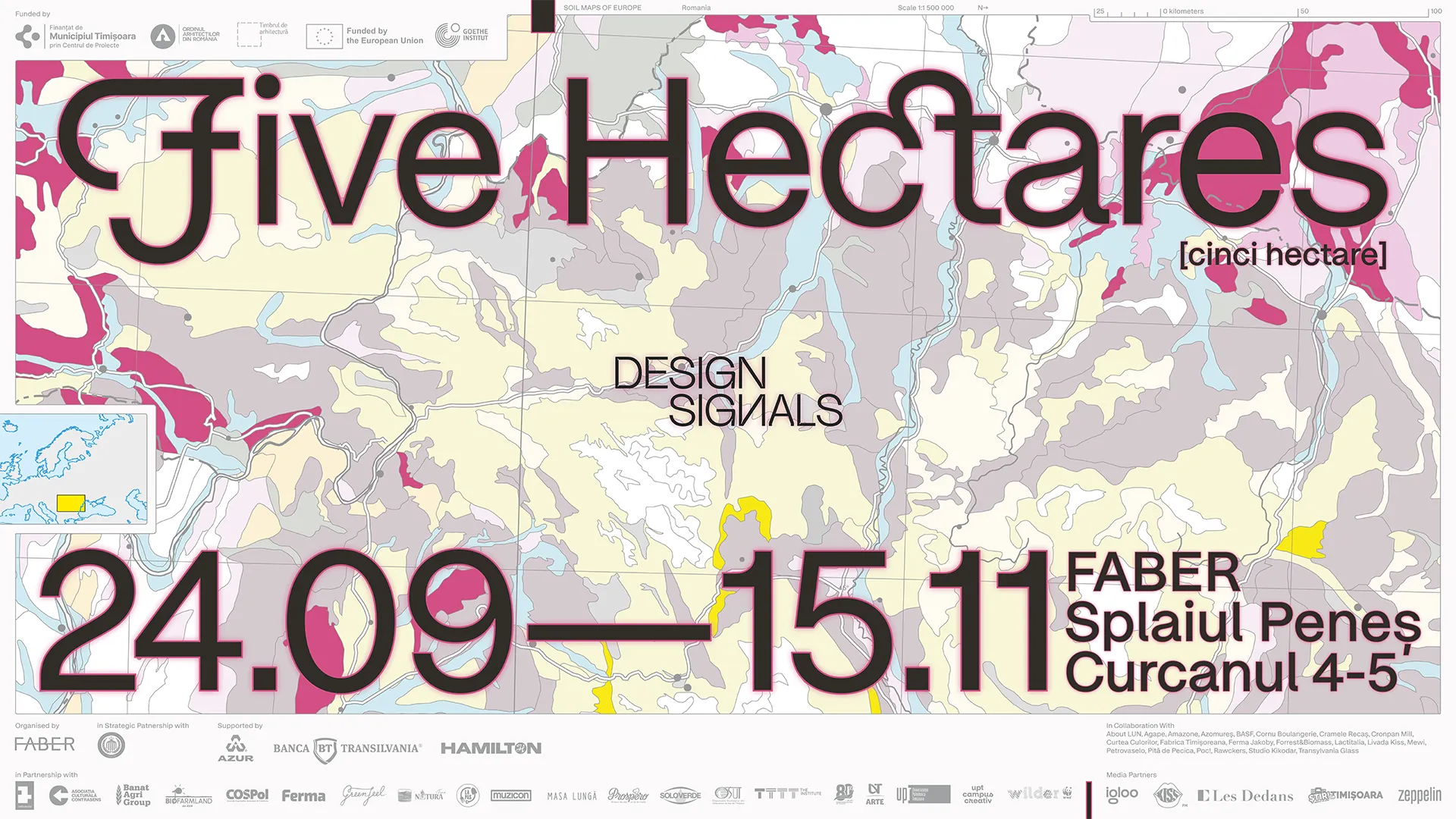
Design Signals returns for its fourth edition with Five Hectares, a research and exhibition programme examining Romania's agri-food industry through the structures that connect farming to finance, technology, infrastructure and international markets.
Opening 24 September at FABER in Timișoara, the exhibition presents newly commissioned design research developed on site in Timișoara and the wider Banat region alongside a data-led visualisation of original research by sociologist Norbert Petrovici.
About the exhibiton
The title refers to a defining threshold in Romanian agriculture. According to the 2023 Farm Structure Survey, 90% of the country's 2.82 million agricultural holdings occupy less than five hectares, yet together they cultivate only 22.9% of its agricultural land. Farms of 50 hectares or more represent just 1% of holdings but cultivate 53.1% of the land.
Five Hectares begins with this highly polarised landscape and asks how differences in scale affect access to machinery, data, finance, storage and markets.
Participating Designers
Alina Turdean
Combining a workshop and dining experience to explore food sovereignty, agricultural traditions and economic structures.
Studio Noff
Investigating plum cultivation and grafting as a form of craft that preserves local varieties while enabling commercial production.
Bruno Baietto
Using bread as a material record of the infrastructures involved in producing it, casting loaves in ceramic and glass.
Studio Eidola
Collects soil from agricultural areas around Timișoara and processes it through a rotary press-molding technique that compresses and seals the material.
Alexandra Lăcătușu, Ioana Man, Yaoyao Meng
Working with agricultural sidestreams to create bioreactive habitats that cultivate moss and register biodiversity.
Roberta Di Cosmo
Following the journey of cheese from pasture to city, comparing industrial and pastoral production.
Thematic Investigations
Three thematic investigations bring parts of the system into closer view. The first examines the expanding role of data in agriculture—sensors, farm-management platforms and the systems through which production can be monitored and automated.
Water provides a second route through the changing agricultural landscape, following a spectrum from open fields exposed to drought to greenhouses where water, temperature and humidity are carefully regulated.
The third considers soil fertility and the industrial role of fertilisers—approaching soil as a living material while examining the global industries developed to measure and maintain its productivity.
The Kitchen Programme
The KitchenA Kitchen Programme extends the exhibition, where agricultural products continue their transformation into food through workshops, meals and events engaging with local practices including fermentation, pickling and preservation.
"The kitchen allows us to follow the supply chain beyond production," says exhibition curator Martina Muzi. "It creates a space where technical and economic questions can be encountered through processes people already know: preparing, preserving, sharing and eating food."
We look forward to welcoming you to FABER.
About Design Signals
Developed by FABER and curated by Martina Muzi,, Design Signals is an annual research and design programme that takes Timișoara as a lens through which to examine wider economic, industrial and political transformations.
Each edition begins with original research led by sociologist Norbert Petrovici, followed by fieldwork, site visits and conversations with people working across the sector under investigation. Local and international designers selected through an open call then develop projects in collaboration with local researchers, producers and institutions.
The programme uses design to make complex systems more legible, amplify existing expertise and forms of everyday design, and create relationships between people and organisations that rarely work together.
Its first three editions investigated the automotive industry in 2023, textiles in 2024 and the chemical industry in 2025.